Making It Easier to Keep Your Landline Number
How I redesigned TalkTalk’s broadband switching journey to support more customer scenarios and make line and number choices easier to understand.
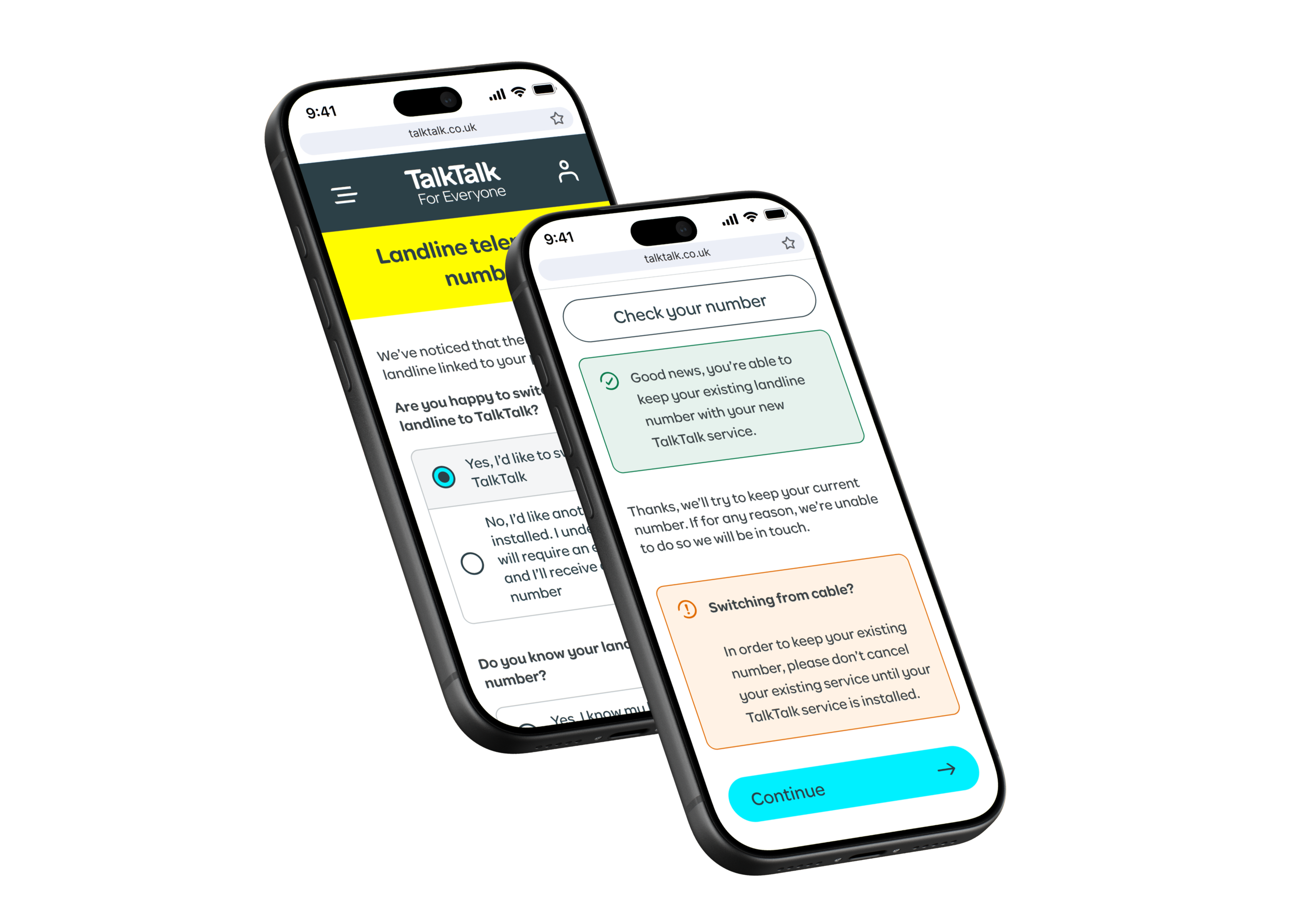
TalkTalk’s online journey only offered to keep a landline number if a working line was detected, so some customers were given a new number without a choice. 28% left at that step and 45% of orders needed a new line.
Worked with product, provisioning and development to map every line-check scenario, then designed and tested interactive prototypes that ask each customer only the questions relevant to their situation.
Participants found the tested journeys easy to understand and logical, and the designs went into development with tracking defined. I left before launch data was available, so the impact is unconfirmed.
Overview
For many customers, keeping their landline number is an important part of switching broadband providers.
At TalkTalk, the online journey did not always give them that choice.
Customers were only asked whether they wanted to keep their number if a working telephone line was detected at their address. This meant some customers, including those switching from Virgin Media, could be given a new number without being offered the option to transfer their existing one.
The journey also did not support customers who wanted an additional TalkTalk line while keeping their existing line with another provider.
I worked with product, provisioning and development teams to understand these different scenarios and create a journey that better reflected what customers needed.
The Problem
The existing journey was shaped by the result of a technical line check.
If a working line was detected, customers could choose to keep their number or get a new one. Other results could lead straight to a new number, without asking what the customer wanted to do.
The information on the page also did not always reflect what would happen during installation or when the service went live.
This created uncertainty for customers and raised concerns about how orders were being processed.
Exit rate at the number-porting step
In the existing journeyOf orders required a new line
The business believed this should be closer to 5–15%Average monthly cost of incorrectly appointed engineers
An operational issue the redesign aimed to help addressThe business wanted to reduce unnecessary new-line orders and engineer appointments. Customers needed clearer choices and a better understanding of what would happen next.
Understanding What Was Possible
The work initially came with an expectation of a solution within one or two weeks.
Before moving into design, I needed to understand why the journey worked the way it did. Changing the questions would only help if the process behind them could support the answers.
I held workshops and working sessions with product owners, provisioning, development and solution design. Together, we looked at how the line check worked, what each result meant and how numbers were transferred between providers.
One useful discovery was that TalkTalk could already transfer numbers from Virgin Media through an older customer portal. The capability existed, but the online sales journey did not offer it to those customers.
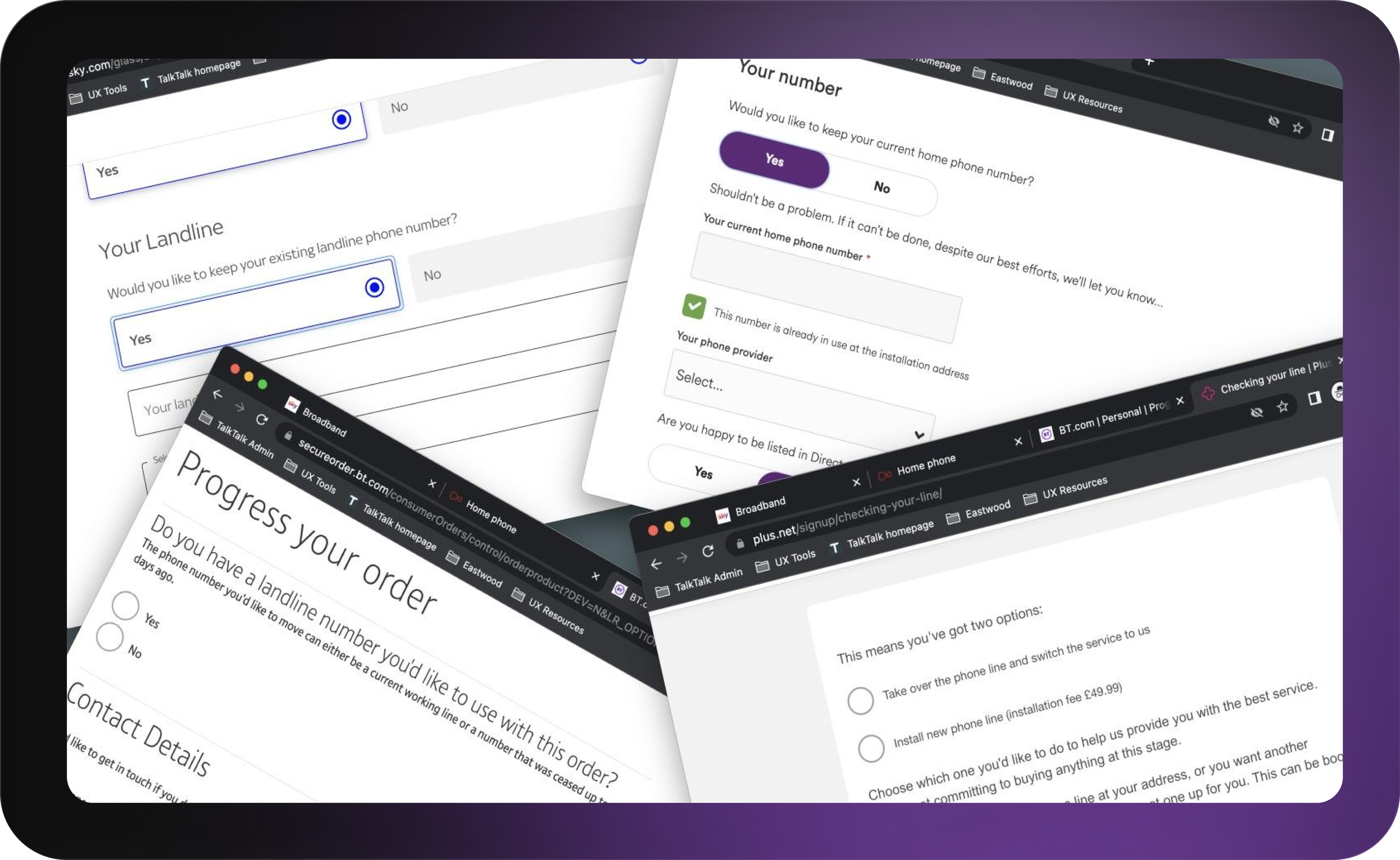
I also reviewed competitor journeys. The competitors I looked at offered number transfers across a broader range of circumstances, including customers switching from Virgin Media.
This helped establish where TalkTalk’s journey needed to change.
Looking at Where Customers Struggled
The exit rate showed that customers were leaving at this step, but it did not explain why.
I looked at navigation data and session replays to understand what was happening on the page.
Some customers scrolled up and down and opened the FAQs. Others paused, returned to the product results or left the site. There were also instances where customers could not continue because the number they entered was not accepted.
These behaviours suggested that customers might not be finding the information or choices they needed.
The design needed to explain the options more clearly and help customers understand the consequences of their selection.
Mapping the Different Scenarios
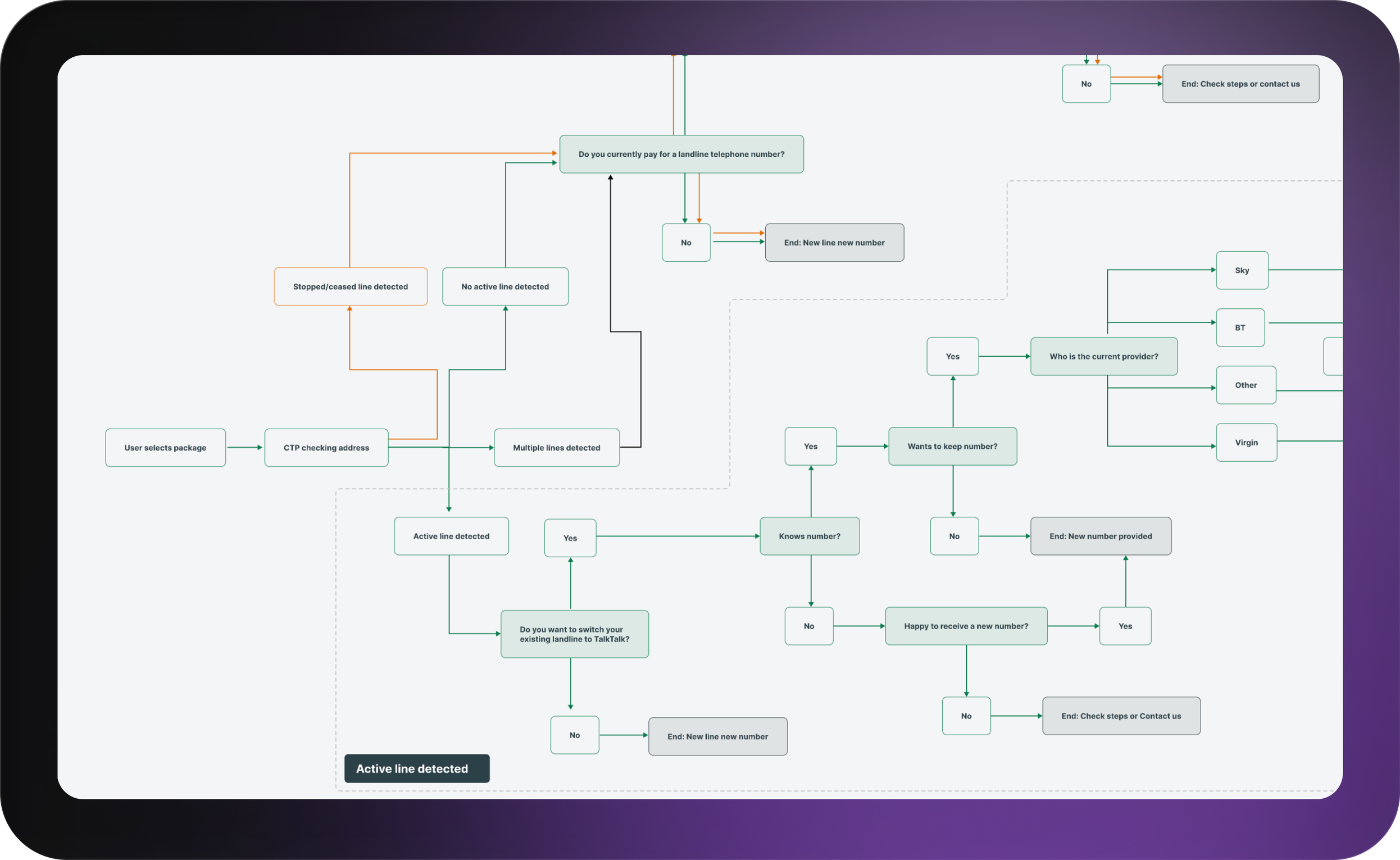
The line check could return several results, including a working line, a stopped or ceased line, multiple lines, or no detected line.
Each result had different implications for what TalkTalk could do next.
I mapped these scenarios with provisioning, looking at where an existing line could be taken over, where a number transfer could be offered and where a new line was required.
I also considered customers who wanted to keep their existing service and add a separate TalkTalk line.
The resulting journey had three starting points, depending on the line-check result. From there, customers would be asked the questions relevant to their circumstances.
The aim was to keep the technical complexity behind the scenes. Customers needed to understand their choices without having to understand how the network worked.
Keep the technical complexity behind the scenes.
Building on an Existing Approach
At the time, TalkTalk was moving its FTTC broadband journey onto the same technology stack as FTTP.
My colleague had already designed and tested the number-porting experience for FTTP. This gave me a useful starting point.
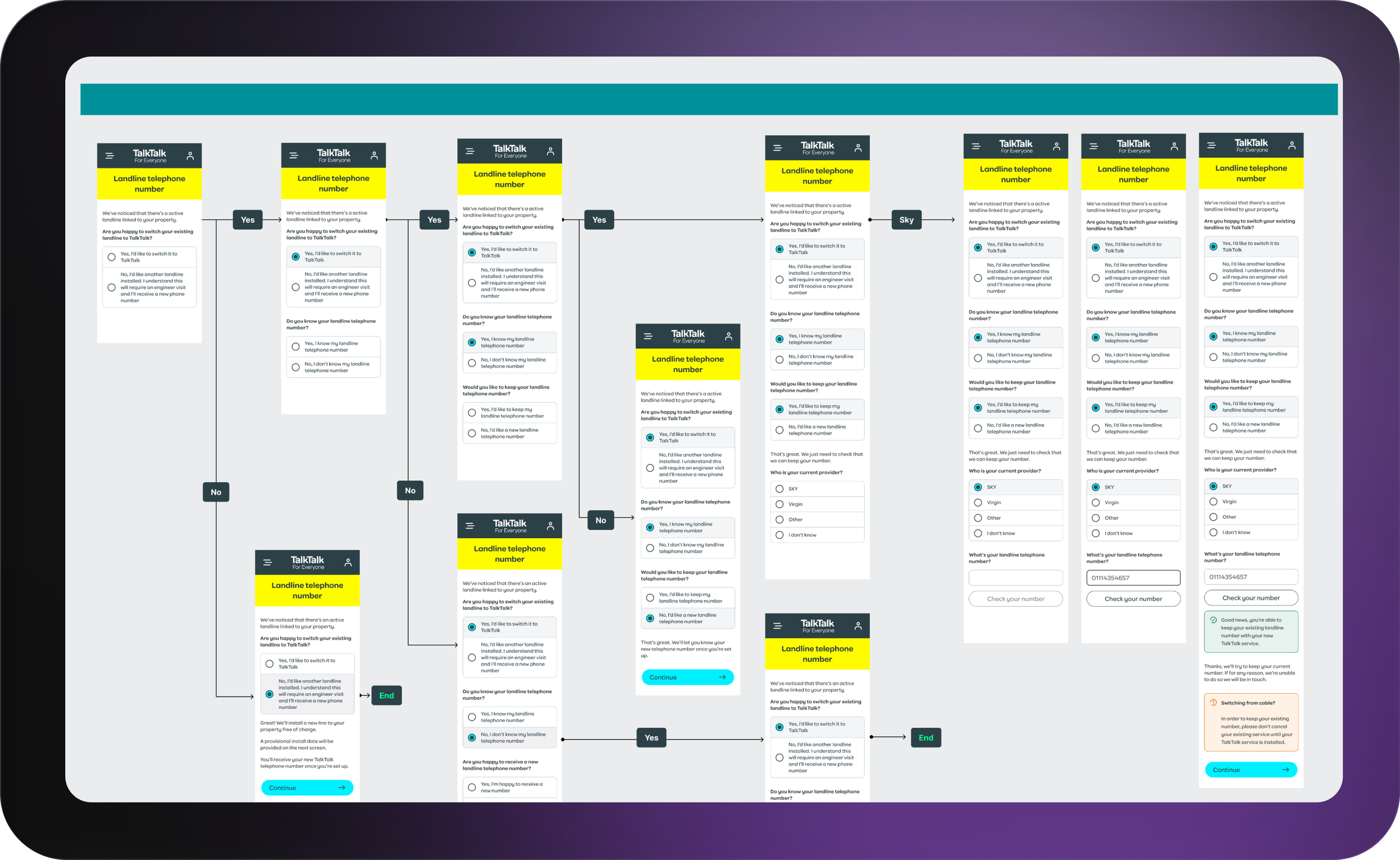
I adapted that approach to fit the FTTC line-takeover scenarios, working regularly with provisioning to check the questions, routing and outcomes.
Using an existing design foundation helped keep the experience consistent. It also allowed me to focus on the parts of the journey that needed to work differently for these customers.
Testing the Questions and Flow
I created interactive prototypes for the working-line and stopped-line takeover journeys.
The testing focused on three things:
- Whether customers understood the questions.
- How they interpreted the available answers.
- What they expected to happen after making a selection.
Participants found the tested journeys easy to understand and logical. No issues were identified with the questions or responses during those sessions.
This gave me confidence to take the designs into development.
Outcome
The work produced a tested journey that addressed gaps in the existing experience and supported a wider range of customer circumstances.
Customers could be guided through choices relevant to their situation, with the underlying logic reviewed alongside provisioning.
I walked the development team through the designs and the reasoning behind them, supported by interactive prototypes. I also attended refinement sessions to answer questions as the work progressed.
To help the team understand performance after launch, I requested more detailed event tracking and defined the measures I would need to monitor:
- Exit rates at the number-porting step.
- Successful number transfers.
- New-line orders where an existing line could be reused.
- Incorrectly appointed engineers and the associated costs.
I left TalkTalk before post-launch performance data became available, so I could not confirm the impact on these measures.
Reflection
One of the most useful discoveries was that a number transfer the online journey did not offer was already possible elsewhere in the business.
That changed my understanding of the problem. It showed why I needed to look beyond the screens and understand the process behind them.
The scenario mapping was equally important. What initially looked like a small set of questions involved several line states, customer needs and provisioning rules. Working through those together helped me make the customer-facing journey simpler.
The project also showed the value of building on work that had already been tested. Adapting the FTTP approach gave me a consistent foundation while leaving room to address the differences that mattered for FTTC customers.